
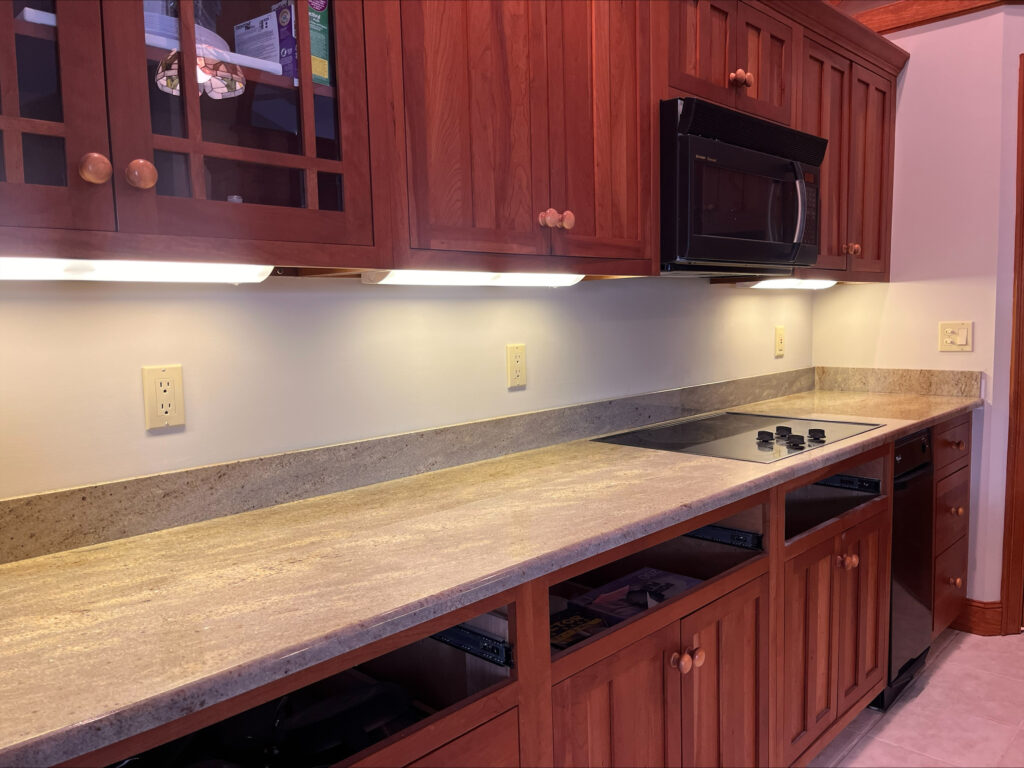
Few decisions in a countertop project carry as much weight as the finish. Astoria granite countertops resolve that tension in a distinctive way. The same slab delivers two entirely different surface experiences depending on whether you choose polished or leathered, and the Concord, NH kitchen documented here shows exactly what that looks like in practice.
At 3CM thickness with a finished edge, this installation represents the standard of work Rumford Stone has built over three decades in Northern New England.
What Makes Astoria Granite Countertops Distinctive
Granite countertops are among the most enduring choices in residential stonework, and Astoria earns its place at the top of that category for specific reasons. Specifically, its palette moves between warm cream tones and deep chocolate veining threaded with grey a composition with enough visual weight to anchor a kitchen without competing with cabinetry, hardware, or fixtures.
The 3CM slab thickness matters more than it might initially appear. Moreover, it determines how the edge profile reads, how well the stone performs at unsupported overhangs, and the overall sense of permanence once the countertop is in place. In contrast, thinner profiles can subtly undermine the solidity that makes natural stone feel genuinely invested-in rather than simply selected.
The finished edge on the Concord project completes the impression. Furthermore, a well-executed edge transforms a countertop from raw material into a finished architectural element. Astoria’s natural movement responds well to clean geometry — a straight-cut profile lets the stone’s own character remain the primary visual without the distraction of ornamental detailing.
Polished vs Leathered: Choosing Your Astoria Granite Finish
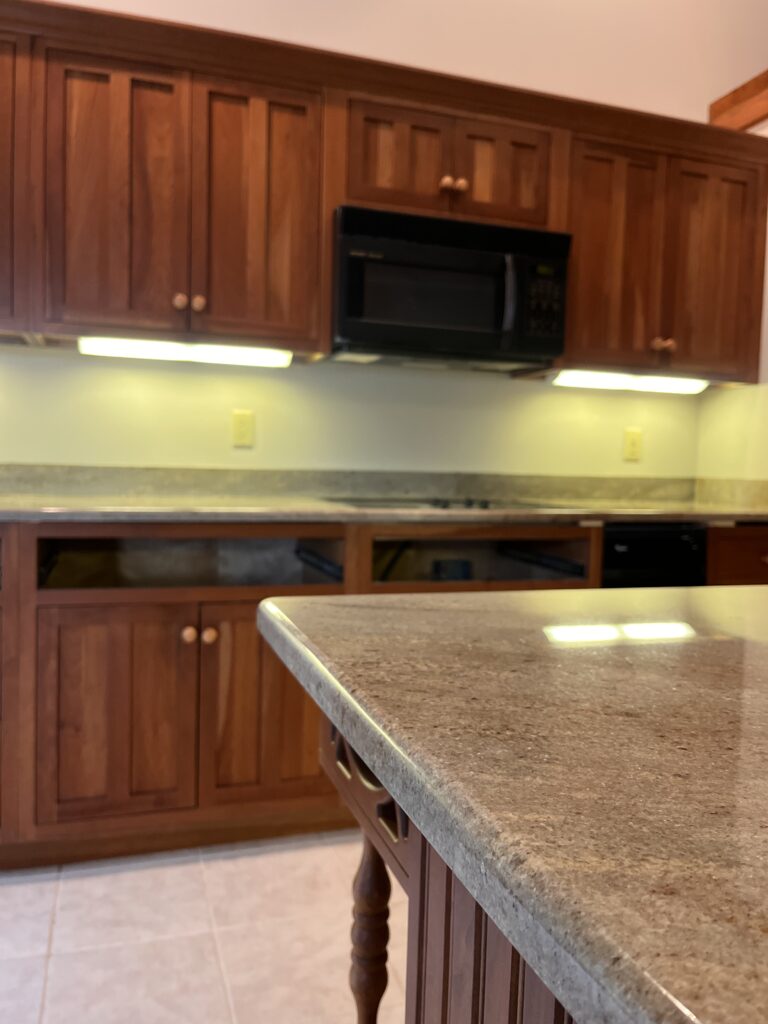
One of the defining choices in the Concord project was the dual-finish approach. Astoria granite accepts both treatments with equal composure, and each produces a surface that reads as distinct even when drawn from the same slab.
| Finish | Surface Character | Fingerprints | Glare | Daily Cleaning |
|---|---|---|---|---|
| Polished | High-gloss, highly reflective | Very visible | High | Single-pass wipe on smooth face |
| Leathered | Textured matte, richer colour | Well hidden | Very low | Soft brush for grooves; straightforward overall |
Polished granite showcases Astoria’s veining at its most dramatic. The reflective surface amplifies depth, particularly under pendant lighting above a kitchen island or beneath large windows. Additionally, the smooth face wipes clean with a single pass, which simplifies cleaning after cooking.
However, leathered granite has emerged as the preferred finish among homeowners who want a surface that holds its appearance in daily use rather than only in a showroom. The diamond-brush treatment used in the leathering process opens the stone’s natural pores slightly and introduces subtle topography across the face. Consequently, fingerprints and everyday marks disappear into the surface texture rather than displaying against a reflective plane. The leathered finish also enhances colour depth. Astoria’s warm tones read richer and more layered under a matte surface than polished granite can convey.
For the Concord kitchen, both finishes appear in the same installation. In particular, this combination demonstrates how a single material can play two different roles within one space providing the visual brightness of polished stone where the design calls for it, and the grounded, low-maintenance quality of leathered stone where daily practicality takes priority.
Installation Process: What the Concord Project Showed
The installation of Astoria granite countertops follows a precise sequence, and shortcuts at any stage show up in the finished result. Because Rumford Stone handles measuring, fabricating, and installing under one roof, there are no handoffs between separate contractors and the coordination failures that come with them.
Templating comes first. Because granite is cut to exact dimensions before arriving on site, the template must account for every wall irregularity, corner angle, and appliance clearance. Even minor measurement errors at this stage translate directly into problems on installation day.
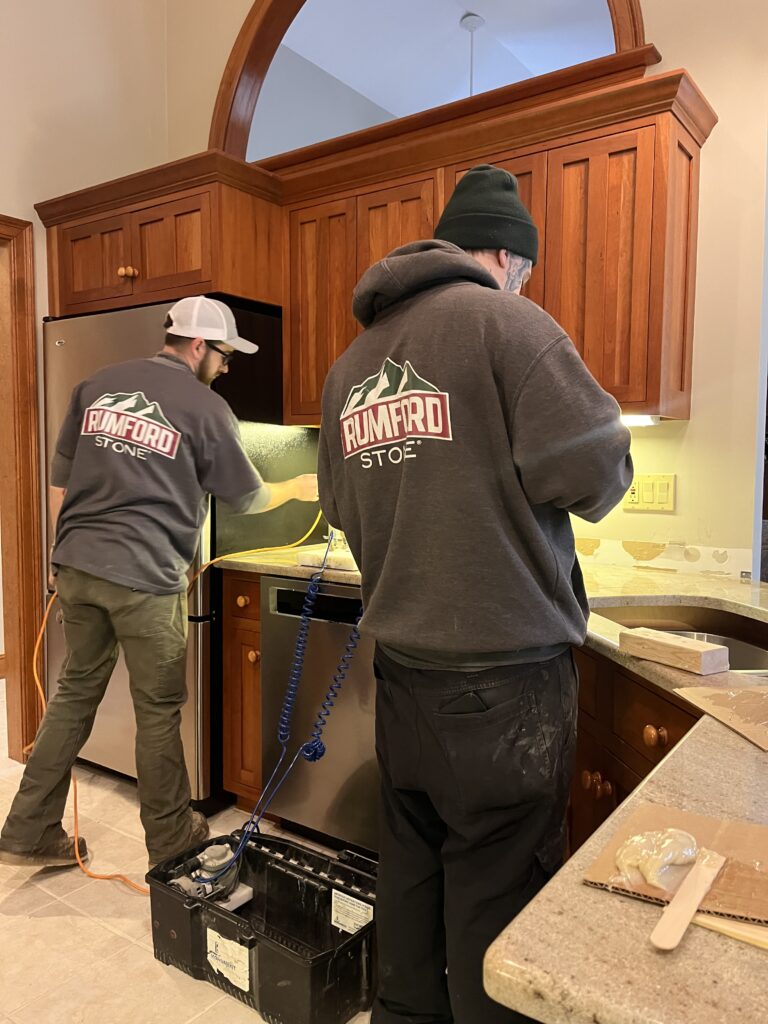
On installation day, slab sections arrive pre-cut and pre-finished. Furthermore, the team positions each piece carefully, aligns the seams, and adheres the stone permanently. Finally, the polishing and cleaning phase confirmed that every surface met the finish specification before the crew left the site.
Common Myths About Granite Countertops
Myth: Granite countertops require sealing every year without exception. Reality: Most dense granite surfaces need sealing once every one to two years, not on a rigid annual schedule. A simple water-bead test tells homeowners when the sealer needs refreshing if water absorbs rather than beads, it is time to reseal. Furthermore, quality granite sealed properly at installation often goes well beyond a year before the sealer shows any sign of wearing.
Myth: Granite cracks easily under normal kitchen conditions. Reality: Granite ranks among the hardest natural stones used in residential construction. Although a thin, unsupported edge can chip under severe direct impact, a 3CM granite countertop in a properly supported installation handles the full range of kitchen stresses heat, weight, and sustained use without issue. The Concord installation’s finished edge demonstrates the clean result that careful fabrication delivers.
Myth: Polished granite is always the more sophisticated finish choice. Reality: Finish preference is a design decision, not a quality hierarchy. Leathered granite has earned significant recognition among designers and homeowners precisely because the texture adds depth and character that polished stone cannot replicate. Ultimately, the right finish depends on the kitchen’s lighting, cabinetry tone, and how the surface will realistically be used day to day.
Frequently Asked Questions About Astoria Granite Countertops
What is the difference between polished and leathered Astoria granite countertops?
Polished Astoria granite has a reflective, high-gloss surface that showcases the stone’s veining at maximum visual depth. Leathered Astoria granite receives a diamond-brush treatment that produces a subtle textured matte richer in colour, lower in glare, and far more forgiving of fingerprints and everyday kitchen marks. Both finishes come from the same stone and carry identical material quality. The choice is entirely about design intention and how the surface will perform in daily use.
Do Astoria granite countertops need sealing?
Yes. Granite is a natural stone with a slightly porous surface, and Astoria granite countertops should be sealed as part of installation. Plan to reseal every one to two years depending on how actively the surface sees use. Reputable fabricators seal the surface as standard before handoff — confirm this is included when discussing your project scope.
Where do Astoria granite countertops work best in the home?
Kitchen countertops and islands are the most common application, but Astoria granite performs well across any space where a durable, characterful surface belongs. Additionally, bathroom vanities, bar tops, and fireplace surrounds benefit from the same warmth and durability. The leathered finish is particularly suited to bathroom environments the texture adds tactile interest while concealing water marks and residue that show readily on polished surfaces.
Astoria Granite in Practice: What the Concord Project Delivers
When evaluating Astoria granite countertops for a kitchen remodel, the Concord installation provides a practical reference a real project, completed by Rumford Stone, showing what the material and the dual-finish approach produce in a finished residential space.
The result reflects what three decades of in-house fabrication experience looks like when applied to a single kitchen. Precise seams, clean edges, and surfaces finished to the homeowner’s specification polished where the veining deserved to be seen, leathered where the working reality of a kitchen called for it.
Rumford Stone fabricates and installs Astoria granite countertops and a full range of natural stone surfaces for homeowners across New Hampshire, Vermont, Massachusetts, and Maine. View full slabs at the Bow, NH slab yard, or reach out to begin the conversation about your project.




