
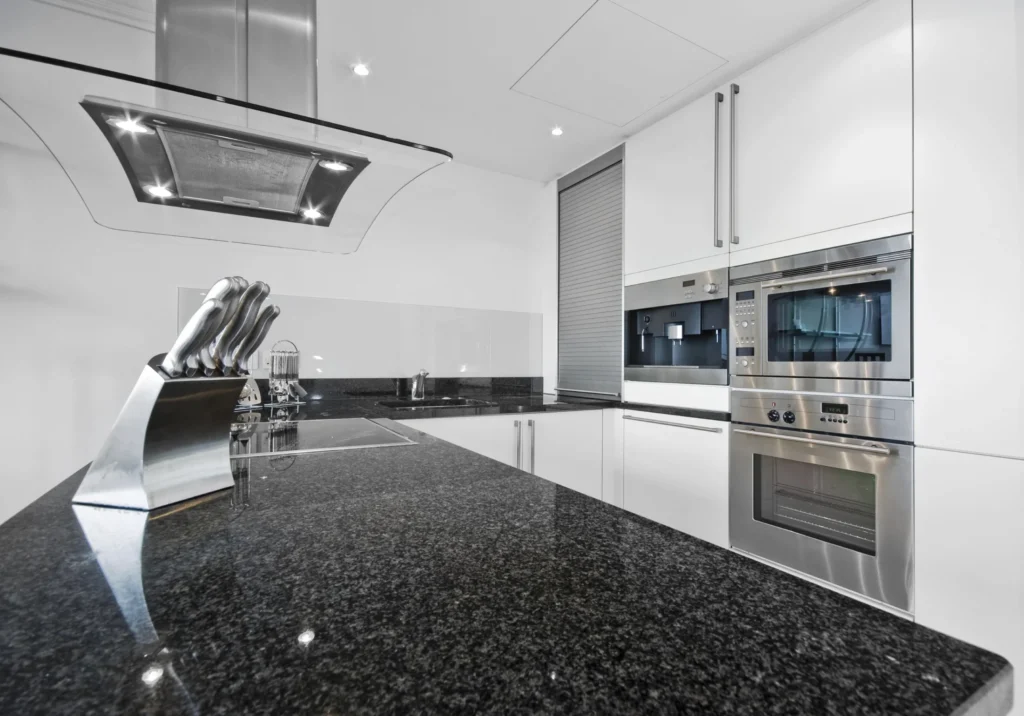
Not every countertop finish performs the same way in a working kitchen. Leathered granite countertops offer something polished stone cannot a tactile surface that grips rather than gleams, catches light softly rather than sharply, and conceals fingerprints and water marks far more effectively than a mirror-polished slab. Rumford Stone carries two standout granite varieties in this finish: Black Pearl and Silver Gray.
What Granite Is — and Why the Leathered Finish Changes Everything
Granite is an igneous rock that forms when molten magma cools slowly deep within the earth. That slow cooling produces the interlocking crystal structure feldspar, quartz, and mica are responsible for granite’s characteristic speckled pattern and exceptional hardness. Furthermore, no two slabs share the exact same mineral arrangement. Every installation is genuinely one of a kind.
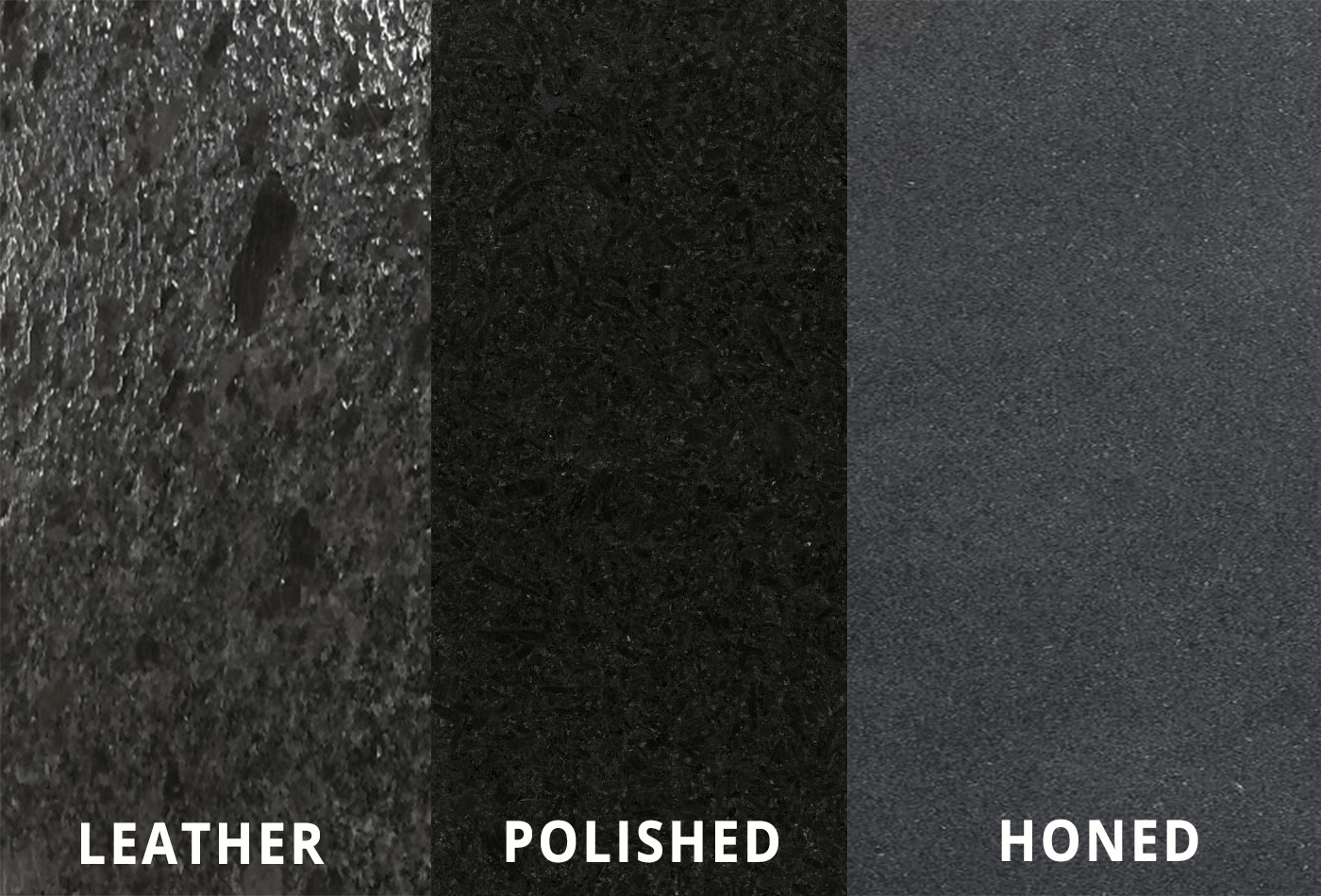
The leathering process takes that surface through a series of brushed abrasion passes that open the grain and break up the polished face. Consequently, the result is a matte, tactile finish that preserves the stone’s natural depth while eliminating the mirror-like reflection. Moreover, leathered granite performs better in daily kitchen use. Fingerprints that show clearly on polished black granite blend into the texture and become nearly invisible.
Black Pearl Granite — Dual-Sided Slab, Low Glare, High Character
Leathered granite countertops in Black Pearl present a deep charcoal base with fine mineral movement. The kind of surface that commands attention without demanding it. Additionally, Rumford Stone’s Black Pearl slabs come dual-sided. Both the leathered face and the polished face are accessible on the same slab. Specifically, this allows homeowners who want to compare both finishes to do so with a single stone in hand.
Because the leathered finish reduces reflectivity significantly, Black Pearl performs especially well in kitchen spaces with strong overhead lighting or large windows. Overall, intense light on polished black granite reads as glare; on the leathered surface, the same light becomes quiet, dimensional texture.
Silver Gray Granite — Lighter Tone, Larger Flecks, Wider Range
Silver Gray is closely related to Black Pearl in base tone but slightly lighter. Its larger mineral flecks create more visible natural variation across the slab. In addition, those larger flecks, darker zones, lighter zones, and mid-tones that tie the composition together and give Silver Gray a richer movement at distance. Although Silver Gray is still a dark stone, it reads as versatile against a wide range of cabinet colors from deep navy to soft white.
Rumford Stone carries Silver Gray in both leathered and polished finishes. However, the leathered version is where Silver Gray’s natural variation fully comes forward. The matte texture catches light differently across each mineral zone, giving the surface a quiet complexity that polished stone tends to flatten.
Leathered vs. Polished Granite — What Actually Changes
Choosing a finish matters as much as choosing the stone. Both leathered and polished granite originate from the same slab. The distinction lies entirely in how fabricators finish the surface.
| Factor | Leathered Granite | Polished Granite |
|---|---|---|
| Surface Feel | Matte, slightly rough, tactile | Smooth, mirror-like |
| Light Reflection | Low glare, soft diffusion | High glare, sharp reflection |
| Fingerprint Visibility | Low — texture conceals marks | High — marks show clearly |
| Maintenance | Wipe clean; seal annually | Wipe clean; seal annually |
| Best Setting | High-light kitchens, casual spaces | Formal kitchens, showpiece applications |
Each finish follows the same annual sealing schedule. Nevertheless, leathered surfaces tend to show less daily wear between cycles because the matte texture forgives condensation rings, touch marks, and light surface contact that polished stone would register immediately.
Carrera Trenita Viatera — The Third Color Worth Knowing
Not every surface in a kitchen needs to be natural stone. Rumford Stone’s quartz countertops include Carrera Trenita Viatera by Viatera (LX Hausys) — the showroom’s top-selling quartz color. Moreover, it earns that position for a simple reason: the bright white base and subtle gray veining work across nearly every cabinet color.
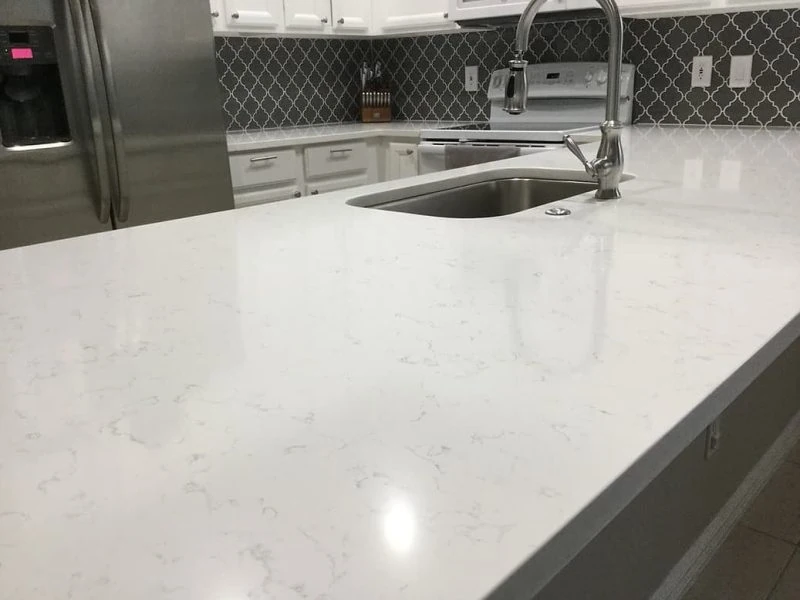
Specifically, Carrera Trenita Viatera pairs cleanly alongside both Black Pearl and Silver Gray. It works well in kitchens where multiple surfaces are in play. A leathered granite island next to quartz perimeter runs, for instance. Additionally, quartz requires no periodic sealing, which makes it a practical choice for secondary surfaces in the same project. Furthermore, the bright white of the Viatera reads as a natural counterweight to the darker granite tones. The result is clear visual contrast rather than competition.
Choosing Your Leathered Granite Countertops
Planning your countertops is more straightforward once you see the three options side by side. For kitchen applications, Black Pearl suits dark cabinetry navy, charcoal, or black-stained wood. Where a polished surface would compete for attention. Silver Gray opens up more cabinet pairings and works equally well in bathroom vanity applications. Its larger flecks and mid-tone variation read as intentional and refined in those settings.
Carrera Trenita Viatera fills the third position the bright, low-maintenance engineered option that complements the natural stone choices without demanding the same care routine. In summary, the three colors cover the full range of what most Northern New England kitchens and bathrooms actually need.
Seeing the full slab under real light is essential before committing. Rumford Stone’s slab yard in Bow, NH is open by appointment, and the Pembroke showroom carries samples of all three surfaces.
Frequently Asked Questions About Leathered Granite Countertops
Are leathered granite countertops harder to clean than polished?
No — leathered granite countertops clean with a damp cloth and a pH-neutral cleaner, the same routine as polished stone. In fact, the matte texture tends to hide smudges and condensation marks that would show immediately on a polished black surface. Specifically, during sealing, the leathered surface may require slightly more attention to ensure the penetrating sealer reaches all surface pores evenly.
Do leathered granite countertops need to be sealed?
Yes — granite is a natural stone and requires periodic sealing regardless of finish. For most kitchen applications, annual sealing is the standard schedule. However, the water drop test tells you exactly when the time has come: if water beads on the surface, the seal is holding. If water absorbs within a few minutes, resealing is due.
How does leathered granite compare to leathered quartzite?
Both leathered granite and leathered quartzite countertops share the same matte texture and low-glare character. Granite is an igneous rock with a speckled mineral pattern; quartzite is a metamorphic stone with flowing, directional veining. Additionally, quartzite is typically harder than granite and carries more dramatic visual movement. Consequently, the choice comes down to whether you want a quieter, mineral-speckled surface or a stone with visible sweeping veining.
The Finish That Changes How a Kitchen Reads
Leathered granite countertops offer what polished stone cannot replicate a texture you can feel, light you can live with, and a surface that wears gracefully rather than showing every mark. Black Pearl delivers depth and restraint. Silver Gray brings versatility and natural variation. Carrera Trenita Viatera rounds out the trio with a bright engineered option that requires no sealing. All three are in Rumford Stone’s showroom.
Visit the Pembroke showroom or request a quote to schedule a slab viewing at the Bow, NH slab yard — seeing these stones in person, in your project’s light, is the only way to make the right call.




