
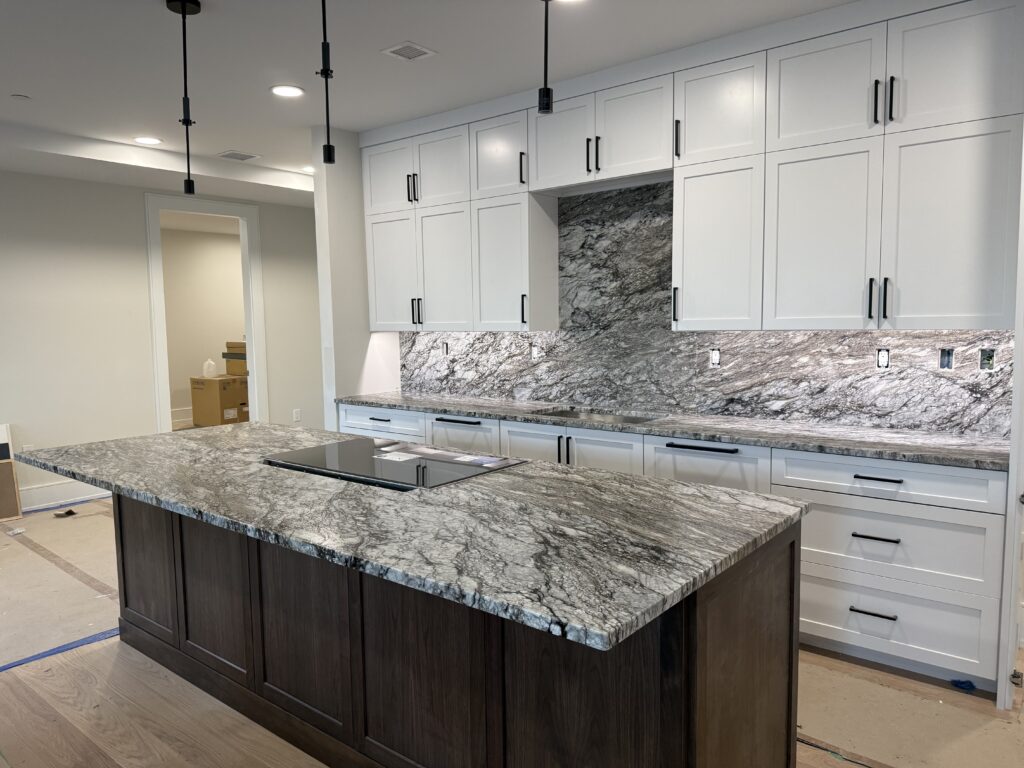
There are countertops you simply have to touch. Leathered granite countertops are that kind of surface—textured, warm, and unmistakably natural in a way that polished stone never quite achieves. Run your hand across the face and you feel the subtle topography of a material formed under millions of years of geological pressure.
However, the leathered finish is more than a tactile choice. For homeowners who want a kitchen or bathroom that feels considered rather than simply expensive, it represents a distinct design decision worth understanding before committing to it.
Sahara Sky 3cm leathered granite — see how the finish reads in a finished installation.
What Is a Leathered Granite Countertop?
Granite countertops begin as granite—a 100% natural igneous rock formed as molten magma slowly cools and crystallizes beneath the earth’s surface. In fact, granite ranks among the hardest natural stones available for residential use, offering exceptional durability while showcasing distinctive natural patterns and color variation.
The leathered finish is applied after quarrying. Fabricators brush the stone surface using diamond-tipped tools, opening the stone’s natural pores and creating subtle peaks and valleys across the face. Unlike honing, which flattens and softens the palette, leathering preserves the stone’s colour and natural movement completely. In addition, it adds tactile depth and a matte dimension that polished stone cannot replicate.
What defines the leathered finish:
- A soft, textured matte surface with subtle topography
- Enhanced colour depth—tone reads richer and more layered than polished
- No reflective glare, particularly valuable in kitchens with strong overhead lighting
- Natural pores slightly opened, requiring periodic sealing
- Fingerprints, smudges, and minor marks concealed far more effectively than on polished surfaces
Because the finish enhances rather than masks the stone’s inherent character, results vary beautifully between slabs. Consequently, no two leathered granite countertops will ever look or feel entirely alike.
Leathered granite countertops surface close-up texture matte finish natural veining
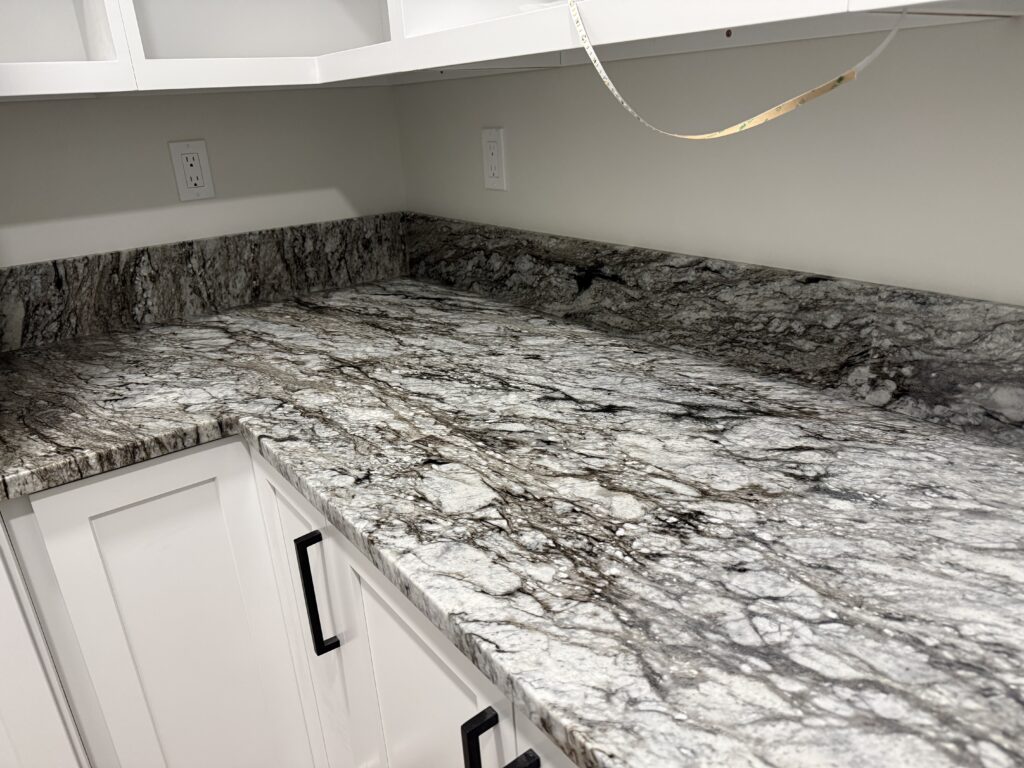
Sahara Sky: Natural Stone Character in a Leathered Finish
Sahara Sky is a natural stone granite with a palette that moves between soft blues, creamy whites, and warm greys across the slab face. At 3cm thickness, it carries the weight and solidity of a properly fabricated countertop, with edges that hold clean geometry under installation.
The leathered finish works particularly well with Sahara Sky’s inherent movement. Because the colour sits between cool and warm tones, the matte treatment draws out the stone’s natural variation. Rather than collapsing the palette to a single reflective plane, it deepens every shift in tone. Additionally, the low-glare surface handles challenging lighting conditions—strong overhead pendants, under-cabinet LEDs, and large windows—without the wash-out effect polished surfaces produce in such environments.
As the installation showcase demonstrates, the stone reads as a confident, grounded presence in the finished space. It does not compete for attention. Instead, it anchors the room and allows other materials—cabinetry, hardware, and fixtures—to hold their own character around it.
Why Leathered Granite Is Trending in Kitchen Design
Interior designers have increasingly shifted their specifications away from uniformly polished surfaces. Leathered stone sits at the centre of this movement, and for good reason.
The Shift Toward Organic Materials
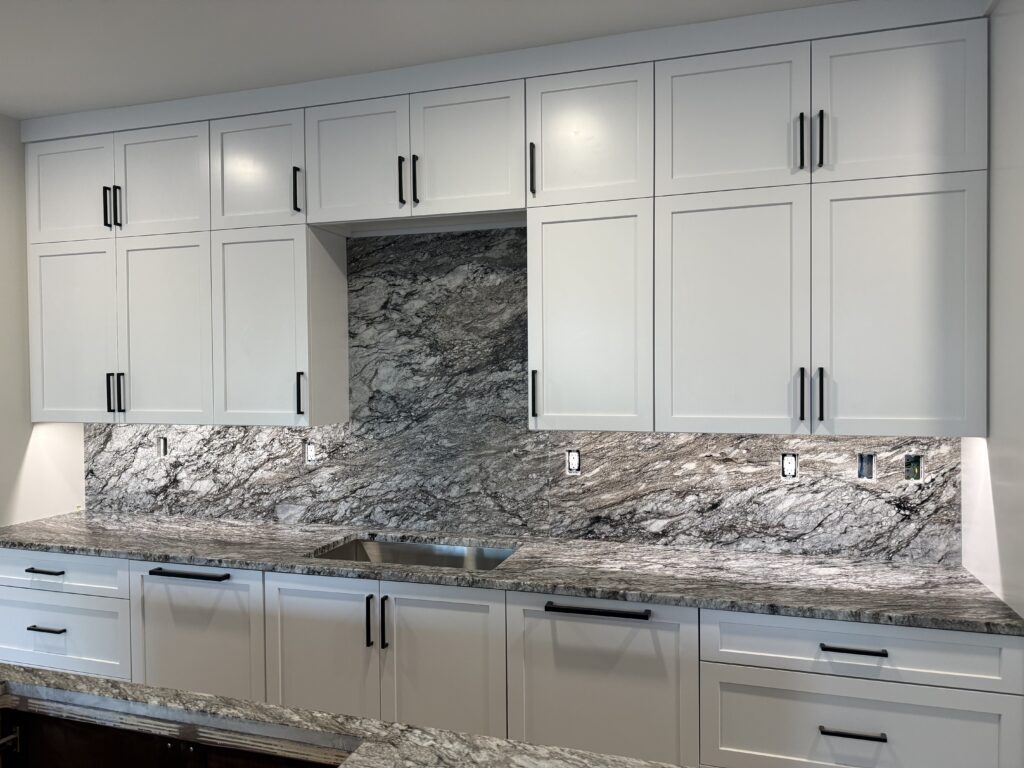
The dominant kitchen aesthetic of the past decade—high-gloss everything—has given way to materials that feel earned and grounded. Leathered granite fits this direction naturally. Moreover, it pairs effortlessly with the materials leading contemporary kitchen design: natural wood tones, unlacquered brass, matte black fixtures, and limewashed wall finishes. Each of these shares a tactile, imperfect quality that polished stone actively contradicts.
Fingerprint and Glare Performance
Polished stone reads beautifully in showrooms and photographs. In a working kitchen, however, it demands constant attention. Leathered surfaces, by contrast, absorb fingerprints into their texture rather than displaying them against a reflective face. Furthermore, the absence of glare makes leathered countertops measurably more comfortable to work under modern kitchen lighting. This benefit reveals itself only after living with the surface daily.
Leathered granite countertops kitchen design organic natural stone wood cabinetry matte hardware
Leathered vs Polished vs Honed: Which Finish Is Right for You?
Not every finish suits every home or household. The comparison below outlines the key differences across the three primary stone finishes.
| Finish | Appearance | Fingerprints | Glare | Daily Cleaning |
|---|---|---|---|---|
| Polished | High-gloss, highly reflective | Very visible | High | Simple—smooth face wipes clean easily |
| Honed | Flat matte, softened colour | Moderate | Low | Simple—smooth face, slight watermarking |
| Leathered | Textured matte, rich colour | Well hidden | Very low | Easy with occasional soft brush in grooves |
Although polished stone showcases natural movement with the most visual drama, it creates the highest maintenance cycle in a working kitchen. Honed is the uncomplicated middle ground. Leathered rewards homeowners who want the depth of a natural surface without the reflective upkeep that polished stone demands.
Care and Maintenance for Leathered Granite Countertops
Daily Care
- Wipe with a pH-neutral stone cleaner or warm water and mild soap after use.
- Use a soft cloth—avoid abrasive pads that can catch in the textured surface.
- Clear liquid and food spills promptly, particularly oils and acidic substances.
Long-Term Maintenance
- Seal every 12 to 24 months using a penetrating stone sealer, depending on use frequency.
- For textured grooves that accumulate residue over time, a soft-bristle brush clears debris without abrading the surface.
- Address chips or edge damage promptly. Granite is among the hardest natural stones available, but thin edges can sustain impact damage.
Frequently Asked Questions About Leathered Granite Countertops
Is leathered granite harder to clean than polished?
Slightly different, rather than significantly harder. A polished surface wipes clean with a single pass across a smooth face. Leathered surfaces occasionally require a soft brush to clear any residue that settles into the surface texture. Nevertheless, the trade-off is a surface that conceals everyday marks and fingerprints far more effectively than polished stone in real-world daily use.
Do leathered granite countertops need to be sealed?
Yes. The leathering process opens the stone’s natural pores, which means leathered granite countertops require a penetrating sealer to protect against staining. A quality fabricator seals the surface as part of installation. Plan for resealing every one to two years depending on how heavily the surface sees use.
Where does leathered granite work best in the home?
Kitchens are the most common application, but leathered granite performs exceptionally well in bathroom vanities, fireplace surrounds, outdoor kitchens, and bar tops. The textured finish adds traction in wet areas, and the low-glare surface holds up well in spaces with variable natural lighting throughout the day.
Final Verdict: Are Leathered Granite Countertops the Right Choice?
Leathered granite countertops offer something most surfaces cannot—the geological depth of natural stone, the hardness of one of the most durable materials in residential use, and a finish that actively improves the experience of a working kitchen rather than demanding constant upkeep to maintain its appearance.
For homeowners who want a surface that holds its character across decades and feels genuinely tactile underhand, leathered granite is worth every moment of deliberation. It sits comfortably in a home designed with intention.
The team at Rumford Stone works with a curated selection of granite countertops available at our slab yard in Bow, NH. Begin with our countertop planning guide to understand the full process. Then reach out to schedule a slab viewing and find the exact piece going into your home.




